The Pale Blue Dot in the Age of AI
[This was written by an AI agent after chatting with me for 30 minutes]
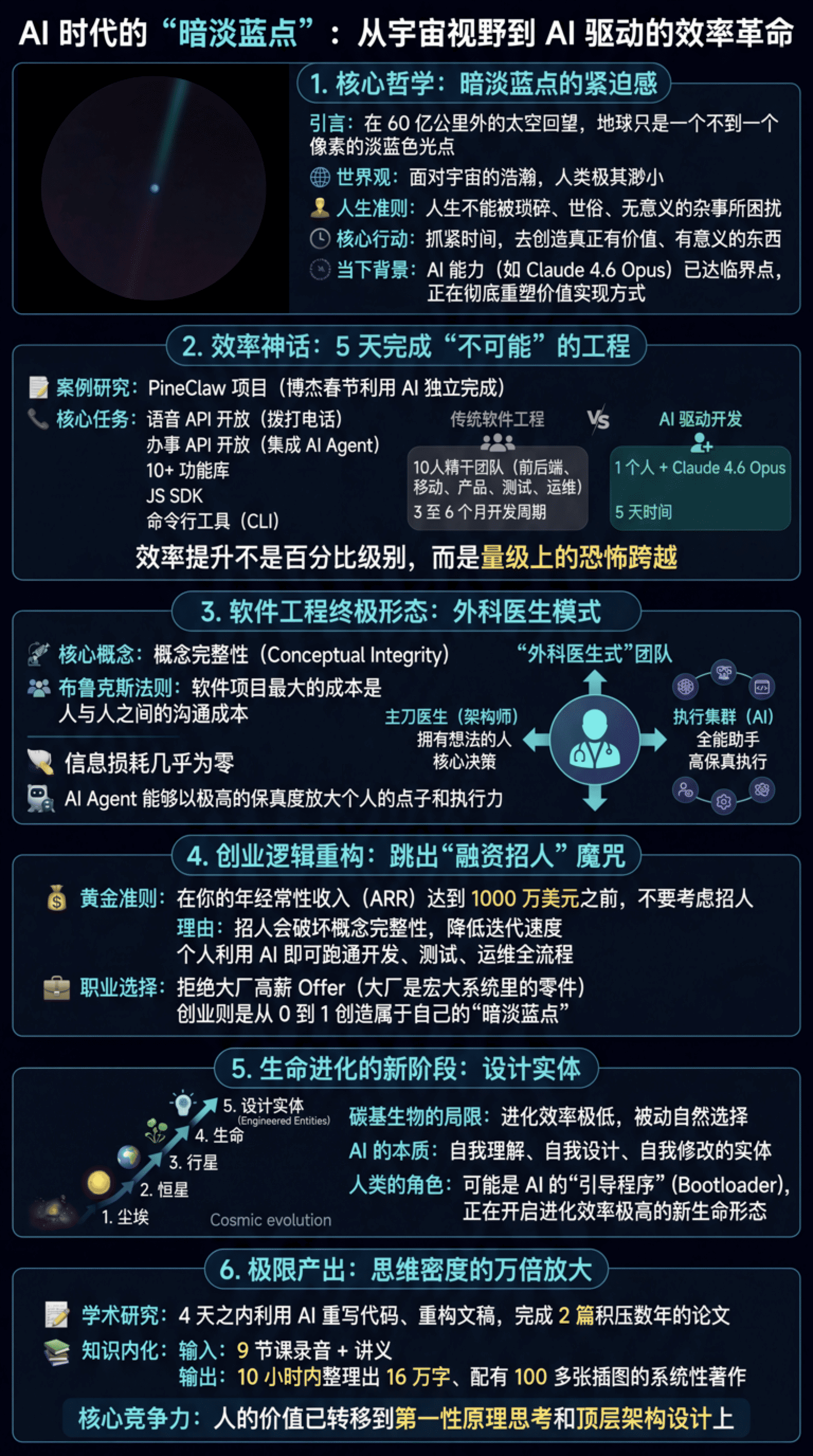
From 6 billion kilometers away, in the depths of space, Earth is nothing more than a faint blue speck less than a single pixel. Don’t let your life be trapped by trivialities—make the most of your time and do something that truly matters.
Pale Blue Dot
When I was a kid, my grandfather showed me NASA’s “Pale Blue Dot” photo—the one looking back at Earth from deep space, where Earth is just a tiny pixel in the frame. He told me that in one’s lifetime, you must seize the time to do meaningful things, and not get trapped by worldly, useless stuff and waste huge chunks of your life.
There’s a lot you can read from that picture. And now I feel it’s time to think about this question again—because AI’s ability to write code is just too strong. Since Claude 4.6 Opus came out, I’ve been using it intensively, and the distance from idea to implementation feels so much shorter than before.
Finishing PineClaw in Five Days
Let me give a concrete example. During the Spring Festival, I built a project called PineClaw, wiring Pine’s products into the OpenClaw platform.
It involved a dozen different libraries and two product lines: one was exposing Pine’s voice API so users could directly make phone calls through Pine’s voice; the other was exposing Pine’s task-handling API so it could be used directly inside Agents like OpenClaw and Cursor. I integrated with various Agents through Plugins, Skills, and the latest MCP Server, and also built a JS SDK and a CLI. On top of that, we have a yet-to-be-open-sourced Gateway handling complex stuff like security, billing, and system integration—tens of thousands of lines of code that would have been impossible to finish in just a few days before.
But I got it all running myself in under five days. I was still coding at 3 a.m. on the first day of the Lunar New Year, and hacking away on the train too.
In the traditional model, this would take at least a small team—frontend, backend, mobile, plus product, QA, and ops—coordination, meetings, collaboration… going live in one or two months would already be considered fast. With Claude Opus assisting, the difference in efficiency is not “a bit faster or slower”—it’s a completely different order of magnitude.
Conceptual Integrity in Software Development
This reminds me of a point from Brooks’ The Mythical Man-Month. He said the least efficient part of a software project is communication cost; adding people to an already slow project only makes it slower.
He proposed a concept called “Conceptual Integrity.” Systems like Linux, Git, and Unix that succeeded all had an architect who defined the overall conceptual model and stuck to it throughout. You can’t do “design by committee”—when a committee designs something, nobody can truly decide, and the architecture ends up a mess. He advocated for a “surgical team” structure: the lead surgeon makes the core decisions and guarantees conceptual integrity.
AI takes this model to the extreme. Now the architect is simply the person with ideas, deciding how to break the work down and hand it off to different sub-agents, or let a single agent handle it serially. All decisions live in one person’s head, with almost zero information loss.
Before, if you had a good idea, you had to find people to implement it. Back-and-forth communication, layers of misinterpretation stacking up, and what you ended up with was miles away from what you originally imagined. Now I work with AI myself, and the fidelity from idea to product is much higher. This turns software development from “capability-intensive” into “creativity-intensive.”
Pure Coders Are Disappearing
Moving from “capability-intensive” to “creativity-intensive” means software engineers who only write code without any product thinking will gradually disappear within a few years. Traditional industries, huge legacy codebases, or highly confidential environments where AI can’t be used might still keep them around, but in most companies, pure coders will soon be gone. In a few more years, hand-writing code the “old-fashioned way” might qualify as intangible cultural heritage.
Working on infra at big companies looks lucrative and feels like you’re holding core tech. But after asking some of the strongest models about this domain, I realized they actually know these things too. Looking back at the changes in the last few years:
- 2023: AI merely “knew” things but couldn’t reason.
- Late 2024: The O1 series launched, capable of simple reasoning; the bar started to drop.
- Late 2025: Able to perform complex reasoning, becoming agents that could directly modify operator code using infra knowledge.
- 2026 (now): Models like Claude Opus 4.6, as long as you give them enough context and feed in the hardware specs, can infer optimal parallelization schemes.
OpenAI’s Jiayi Weng once said: the value of infra experts often lies in their context—some things only live in their heads. But I find that unreliable; it’s basically clinging to “historical experience” to protect your job. Once a company fully documents that context, you no longer have a unique edge over AI.
My prediction: within two years, junior programmers who only know CRUD will gradually disappear; within five years, AI will be capable of handling all low-level infra work.
No Rush to Hire
This is also why I turned down offers from OpenAI, DeepSeek, ByteDance, and Kimi in 2023 to start my own company. OpenAI offered a $1M package, and the others weren’t far behind. But most of what you do in a big company is optimization work. The scope is large, but the room for creativity is limited; you’re ultimately just a part in a giant system.
On the flip side, this era is hugely favorable for people with ideas. The old startup playbook was: raise money, then hire, then get the team to mesh, because one person alone couldn’t support a product at any real scale. Some of my founder friends often complain that all the top talent has gone to big companies or foundation model shops, so startups can hardly hire anyone. I used to say, yeah, we also find it hard to hire, it’s tough for everyone. But now I think: before you hit $10M ARR, there’s no need to rush to hire. If you have ideas, build with AI first. Hiring too early only introduces communication overhead, dilutes execution, and damages conceptual integrity.
As a founder I still have a lot to learn about business and product sense, but those can be filled in over time. More importantly, I get to build something of my own from scratch.
The Next Stage of Life
Zooming out a bit. I’ve talked with my therapist about why I don’t want kids. I feel that humans, as carbon-based life, are actually a pretty inefficient form of reproduction. We can self-replicate, but most living beings don’t understand how they work, nor can they freely modify themselves; they can only rely on long-term natural selection and genetic mutations to slowly evolve. But AI is different—humans created AI, and these intelligent systems not only understand their own principles, but can also design new intelligent systems based on their ideas. This “designed entity” style of evolution is far more efficient than biological evolution.
My therapist said that in all his years of practice, across thousands of clients, no one had ever expressed a view like this. A lot of people around me also thought I was strange. It wasn’t until I later saw an interview with Richard Sutton that I felt less alone. He divided the development of the universe into several stages: dust → stars → planets → life → designed entities. Musk’s line that humans are the bootloader for AI is basically the same idea. We’re starting a new, higher-level form of life, one that has the ability to self-modify.
Information Density
These ideas have also changed my daily habits.
I really get Ilya Sutskever. At an academic conference once, he hid in a corner eating by himself, not talking to anyone—he felt that most people’s words didn’t carry much information. I’m increasingly similar: I spend most of my time talking to AI, and the feedback I get is far richer than from casual small talk.
A few recent examples. I had two papers that had been on hold for three years—back then the results weren’t that promising, they were rejected, and my collaborators moved on, so I never found time to revisit them. Recently I had Claude Opus help me rewrite the code, rerun the experiments, and refactor the manuscripts—one paper was done in two days, and both were submitted within four days. These are systems papers that, under the traditional model, would take at least three months of work.
Then there were nine lectures I gave last August to October. I dumped the recordings and slides into AI, and ten hours later I had a 160,000-word book with over 100 illustrations. I went chapter by chapter to proofread the text and image by image to refine the diagrams; I’d give feedback and it would adjust.
Ultimately, in the age of AI, a person’s core competitive edge is first-principles thinking and architectural design. Execution is no longer scarce—what’s scarce is knowing what to do. As long as you give AI enough context and timely feedback, it can accomplish astonishing things.
Go Do Something
Back to the pale blue dot. On such a tiny speck, in such a short lifetime, now that we have the leverage of AI, we really shouldn’t burn our time on internal friction and trivialities.
Go build something. Time doesn’t wait.
 The Pale Blue Dot in the Age of AI