Psychological Counseling Transcript: Self-Identity and the Explorer’s Worldview
【The following content was整理ed by AI based on a recording, with no modifications made】
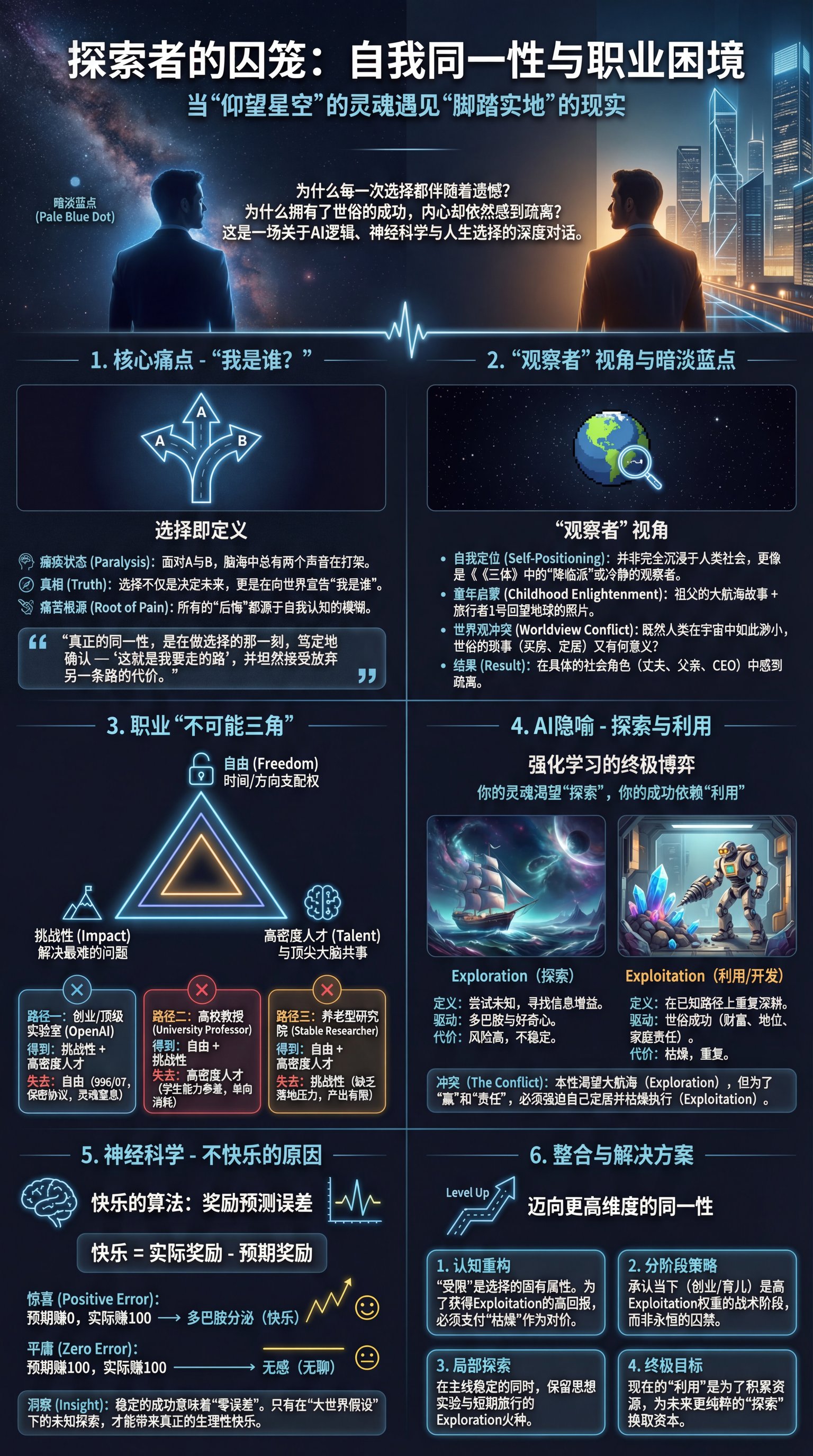
1. Conversation Background and Core Issues Review
Context: Deep psychological counseling and career coaching session.
Participants: A man (client, an entrepreneur with a strong academic background in computer science and artificial intelligence) and a woman (counselor/coach).
Core topic: How to enhance “self-identity/consistency” (Self-Identity/Consistency).
- Prior groundwork: In the previous discussion, they had already touched on the phenomenon of “lack of identity” and the distress it causes.
- Current goal: To dig into the roots of this sense of fragmentation, especially from the dimensions of childhood experiences, the origin of academic thinking, and worldview, in order to find concrete paths to integrating the self, reducing regret, and achieving inner consistency.
2. The Dilemma of Choice and Multiple Definitions of Self
2.1 Choice as Definition: Who Are You?
The man’s confusion:
When facing life’s crossroads (for example, option A vs. option B), he often falls into a kind of paralysis. No matter which path he chooses, there are always two completely different voices fighting in his mind, which leads to regret and a sense of loss regardless of the choice.
The woman’s insight:
- Choice is a projection of identity: Every choice is essentially a declaration to the world of “who I am”.
- Embodiment of values: Once you choose A (for example, pursuing career achievement), it means that at that moment you define yourself as someone who “values career”; if you choose B (for example, returning to a stable family life), it means you define yourself as someone who “values intimate relationships”.
- Root of vagueness: What we call “regret” or “indecision” often comes from fuzzy self-awareness. When a person doesn’t know who they really are or what they truly value, any choice will feel full of anxiety about gains and losses.
- Essence of identity/consistency: True identity/consistency means that at the moment of making a choice, you can firmly confirm that “this is the path I want to take” and calmly accept the price that comes with it (i.e., the cost of giving up the other path).
2.2 The “Observer” Perspective: Hovering Outside Human Society
The man’s self-awareness:
He has a unique understanding of the ultimate question “Who am I?”. He mentioned that deep inside, he doesn’t completely feel like a member of human society, but more like a calm, detached “observer.”
- The Three-Body metaphor: He引用ed the concept from the science fiction novel The Three-Body Problem, describing himself to some extent as similar to the “Adventists” (Eto/Adventists). This doesn’t mean being anti-human, but rather standing outside the system, watching human civilization from a higher-dimensional perspective.
- Sense of detachment: This “observer” mindset causes him, when facing worldly choices (such as buying a house, having children, settling down), to always carry a sense of distance, as if he were watching someone else’s life instead of being truly immersed in his own. This is also a deep reason why he finds it hard to gain complete “identity/consistency” in any specific role (such as husband, father, or CEO).
2.3 The Complexity of Reality: Multi-dimensional Calculation
The man argues against a simplistic “binary choice” narrative. He believes reality is not simply “power vs. beauty,” but is constrained by concrete parameters of external conditions.
- Case analysis: Suppose he faces a choice between “a job” and “an apartment in Beijing”. The decision depends not only on values, but also on how good the job actually is (salary, prospects), and how good the apartment actually is (location, appreciation potential). This is a complex calculation based on real-world parameters, not merely an issue of identity.
3. The “Impossible Triangle” Theory of Career Development
The man described in detail a core model he has distilled from his career, explaining why he feels a certain degree of “lack” and “dissatisfaction” in any role. He believes that for top-tier talent, there is an “impossible triangle” in the modern workplace, where you can usually only get two of the three, but never all three:
- Freedom: Control over time, location, and research direction; flexibility of lifestyle.
- Challenge/Impact: Working on the most cutting-edge, highest-difficulty technical explorations, gaining strong sense of achievement and returns.
- High-density Talent: Working with the smartest, top-tier people in the world and enjoying the thrill of intellectual collisions.
3.1 A Requiem for History and Helplessness in the Present
- The golden age (past): He looks back on history and believes that in certain periods of monopoly (such as the era of the famous Bell Labs), these three factors miraculously coexisted. Scientists at that time had funding and freedom, worked with top minds, and tackled world-class problems.
- The downturn (present): In the current economic environment, where resources are tightening, you can’t have all three; you can only pick two. This forms the root of his professional suffering.
3.2 Deep Analysis of Specific Options
Path 1: Top Frontier Labs (e.g., OpenAI)
- Has: Challenge + High-density Talent.
- Lacks: Freedom.
- Characteristics:
- This is currently the hottest track. You can tackle the hardest problems, surrounded by colleagues of Turing Award caliber.
- Price: Extreme pressure and constraints. Work intensity is often 996 or even 007, running like a machine.
- Confidentiality: Strict NDAs; no papers can be published, no external communication; you work as if in a “black box.”
Path 2: University Professor
- Has: Freedom + Challenge.
- Lacks: High-density Talent.
- Characteristics:
- University faculty have relatively free time and can choose cutting-edge topics.
- Price: Lack of a top-tier team of peers to fight alongside. Students’ abilities are highly uneven and they are still in a learning phase.
- Sense of drain: The man believes that mentoring students is “more output than input.” Teaching them rarely brings him new knowledge; instead it is continuous one-way expenditure, lacking the “intellectual resonance” of masters crossing swords.
Path 3: Government/Non-profit Research Institutes (e.g., some eras of corporate research labs)
- Has: Freedom + High-density Talent.
- Lacks: Challenge/Result orientation.
- Characteristics:
- Similar to a “retirement home for geniuses.” Everyone has a shiny background and high IQ; the work is relaxed and free.
- Price: Lack of real commercial deployment pressure and challenge.
- Experience review: The man mentioned his feelings while doing his PhD at Microsoft Research Asia (MSRA): although surrounded by smart people, much research was just for publications, lacking real industrial impact or urgency in solving real problems, so the final output was limited.
Conclusion: No matter which corner he chooses, he will feel regret over the missing one. This structural lack makes him always feel he is “not in the right place.”
4. Lifestyle Conflict: Family Responsibility vs. Nomadic Longing
Beyond career, the man also faces major internal conflict in lifestyle, closely related to his “observer” identity.
4.1 The “Sense of Constraint” Brought by Family
- Current situation: Married, with a wife who has a stable job in Beijing and a stable family structure.
- Points of conflict:
- Hypothesis: If he were single, he says he would unhesitatingly choose to go to Shanghai, Silicon Valley in the US, or anywhere else to experience different lifestyles, even switching cities every two or three years.
- Reality: Because of family (his wife’s job is immovable, the child’s education needs), he must settle in Beijing.
- Psychological feeling: This settling down is not out of love for Beijing, but a forced compromise. He describes it as “having signed an agreement”; although he accepts it rationally, at a subconscious level he always feels “trapped.”
4.2 Two Voices in Conflict
- Voice A (happiness): The conventional happiness of “wife, children, and a warm bed,” and the security and support of intimate relationships.
- Voice B (constraint): He must sacrifice mobility for the family and be “fixed” in this physical space.
- The man’s struggle: Rationally, he knows family is important, but in the depths of his “explorer” soul, this kind of stability is equivalent to stagnation. He is not only choosing a place to live, but choosing a fate of being bound.
5. Deep Psychological Roots: Childhood Enlightenment and the Origin of Academic Thought
Under the counselor’s guidance, the man looked back at his childhood. This not only explains his current distress, but also reveals the origin of his academic thought as an AI scientist.
5.1 Grandfather’s Enlightenment and the “Pale Blue Dot”
The man’s worldview comes directly from his grandfather’s education when he was a child:
- Enlightenment content: His grandfather often told him stories about the Age of Discovery (Magellan, Columbus, Captain Cook) and about astronomy.
- Core image: The “Pale Blue Dot.”
- This is an image that profoundly influenced him: when Voyager 1 left the solar system and looked back at Earth, the Earth was just a tiny, insignificant, pixel-sized blue dot in the universe.
- Insight: Since humanity is so insignificant in the universe, all the trivial events on Earth (war, politics, housing prices) seem negligible. If one spends their whole life trapped in some small place (for example, in an apartment in Beijing), life loses its grand meaning.
- Self-positioning: This cosmic perspective made him establish from an early age a self-positioning as an “explorer”, and it also led to the “observer/Adventist” mindset mentioned above.
5.2 Definition and Conflict of Worldview
The counselor guided him to clarify the difference between worldview and values:
- Values: Judgments about “what is important” (for example: whether money is important, or happiness is important).
- Worldview: Ontological beliefs about “what the world is like.”
- Jungle assumption: Some people believe the world is a dark forest, full of danger and competition, so they must hoard resources and seek safety.
- Playground assumption: Some people see the world as a playground full of adventures, where the purpose is to experience.
- The man’s worldview: The Large World Assumption.
5.3 Origin of Academic Thought: From Childhood to AI Theory
The man was surprised to find that his childhood experiences directly shaped his core understanding of artificial intelligence, and these theories in turn explain his life dilemmas.
A. Reward Prediction Error
- Theoretical source: A concept at the intersection of neuroscience and reinforcement learning.
- Mechanism: Dopamine (pleasure) secretion in the brain does not depend on how much absolute reward you get, but on the difference between actual reward and expected reward.
- If you expect to earn 0 and actually earn 100 -> huge positive error -> dopamine is released (pleasure).
- If you expect to earn 100 and actually earn 100 -> zero error -> no dopamine (no particular feeling).
- Mapping to life: This explains why “stable success” bores him. In “exploitation” mode, everything is predictable, the prediction error is zero, so there is no pleasure. Only when “exploring” the unknown does he encounter unexpected surprises (Positive Prediction Error), thus generating dopamine.
B. Large World Assumption
- Theoretical origin: Reinforcement learning and cognitive science.
- Small World: Rules are closed, known, and static (such as Go, exams). Here, mastering static knowledge and specific capabilities is enough to win.
- Large World: The world is infinite, open, and dynamically changing (such as real life, the Age of Discovery).
- Definition of intelligence: The man firmly believes that under the “Large World Assumption,” the measure of intelligence is not how much static knowledge it currently possesses, but its learning ability and adaptability.
- Current AI hot topic: This is exactly the cutting-edge “Continuous Learning” direction in today’s AI field.
- Life mapping: Because he holds the “Large World Assumption,” the man believes that stubbornly clinging to a specific skill or a single location is foolish. True wisdom lies in constant movement, continual adaptation to new environments, and ongoing self-remolding.
5.4 Fundamental Conflict: Exploration vs. Exploitation in Reinforcement Learning
The man uses the classic dilemma of Reinforcement Learning (RL) to summarize his life:
- Exploration:
- Definition: Trying unknown paths in order to discover new possibilities and gain information.
- Driving force: Corresponds to the man’s “explorer” soul and his need for dopamine.
- Cost: Low short-term returns, high risk, instability.
- Exploitation:
- Definition: Repeatedly investing in known effective paths to obtain maximum cumulative returns.
- Characteristics: Only focus, repetition, and deep cultivation (such as staying at one company for 10 years, settling in one city) can produce great success in the secular sense (wealth, status).
- Real-world pain point: Entrepreneurial success and family responsibilities both essentially demand extremely high-intensity Exploitation.
- Conflict: His nature (Soul) longs for Exploration (grand voyages, changing maps), but his rational goals (winning, being responsible) force him into Exploitation (tedious execution, settling down).
6. Integration and Acceptance: Moving Toward a Higher-Dimensional Identity
6.1 Cognitive Restructuring: Constraints Are Part of Choice
- Counselor’s feedback: The pain does not come from the choice itself, but from the obsession with “omnipotence.” The man needs to realize that “being constrained” is an inherent attribute of the act of “choosing”.
- Spirit of contract: Since he has chosen the secular goal of “entrepreneurial success,” it means he has signed a contract to “give up part of his freedom.” This is like wanting the high returns of Exploitation while having to pay “tedium” as the price.
- Paying tuition: The man mentioned that his first entrepreneurial failure was because he focused only on exploring technology (Exploration), without understanding operations and management (Exploitation). The current tedium and constraints are the “tuition” he must pay to make up for his shortcomings and to “win.”
6.2 Phased Life Strategy
- Dynamic balance: Even AI Agents need to adjust between Exploration and Exploitation through parameters (such as Temperature). Life is the same; it can’t be all exploration (that’s like a monkey grabbing corn cobs and dropping each for the next), nor can it be all exploitation (that would be stagnant water).
- Solution:
- Phased strategy: Acknowledge that the current stage (entrepreneurial breakthrough period, child’s early years) is a period with a high weight on Exploitation. This is not eternal imprisonment, but a tactical choice for a particular phase.
- Local exploration: While keeping the main line stable, preserve the spark of Exploration in thought experiments, short trips, or academic reflection to satisfy the needs of the “observer.”
- Ultimate integration: Understand that the current “Exploitation” is precisely to accumulate sufficient resources (wealth, influence, capabilities), so that in the future he has the capital to pursue larger-scale and purer “Exploration.”
7. Summary
This conversation reveals the essence of the man’s inner conflict: an observer with a “Large World Assumption” and an explorer’s soul is forced, for secular responsibilities, to compress himself into a stable “Small World” role.
Path to rebuilding identity:
No longer viewing “constraints” as shackles imposed by the outside world, but redefining them as “the strategy an intelligent agent actively chooses at a particular stage in order to maximize long-term returns.” By accepting the psychological gap based on the “reward prediction error” mechanism, the man can find a new balance between “gazing at the stars” (explorer’s worldview) and “keeping his feet on the ground” (real-world executor).